A learned policy's output crosses control, computing, and communication at once. We bind
Projection, Isolation, and Transfer into a single declarative contract enforced
at the ROS 2 middleware interface, and show it holding on Nav2 across two policies and two DDS
backends without touching application or controller code.
Learned policies, planners, and vision-language-action models now sit on the control path of deployed
robots as causal participants. The layer that integrates them with timing, scheduling, and network
guarantees has not been named.
A software harness mediates at the boundary of each tool call. A Physical AI harness cannot, because a
single policy output moves all three axes at once. Its commands shift the controller's trajectory, its
inference time shifts the executor's schedule, and its message payload shifts the link bandwidth.
Robot middleware is the one layer of the robot stack that holds mediating abstractions over all
three axes at once. Operating-system runtimes and safety supervisors enforce individual constraints
more deeply, and orchestration frameworks operate above the loop. Middleware is where per-axis
enforcement can be composed into one contract.
What a learned model has to declare
A deterministic component made three properties implicit by design. Its output range was fixed by
specification, its execution time bounded in closed form, and its operating conditions fixed when it
was designed. The design was as good as the enforcement, so no external layer had to hold anything
separately. A learned model provides none of them implicitly. Each has to be declared, and then
something has to hold the model to it.
Output regionThe values its outputs may occupy. A learned output is a sample from a
distribution, so the stability margin a classical controller relied on becomes a function of an
input that nobody bounded.
Inference budgetThe computation it may consume. Inference runs for an
input-dependent time with no tight closed-form bound, which breaks the schedulability argument the
real-time layer assumed.
Operating regimeThe conditions under which its outputs stay trustworthy. The result
crosses a shared network as a payload of variable size and cadence, so the bounded-delay envelope
no longer holds.
The open question is which layer can hold all three at once. The middleware community already took on
the governance of learned workloads in the cloud, isolating multi-tenant GPU kernels and admitting
inference requests by predicted quality. On the robot the picture is less settled.
When a harness is not needed
Not every learned component needs one. The harness is needed only when the model is a real-time
causal participant that is unbounded on all three axes at once. Three common cases fall outside it,
because a classical component already holds the bounds the harness would supply.
A learned perception stage whose estimate a verified controller re-bounds.
An advisory planner that a human vets before execution.
An offline or non-real-time planner that sits outside the control loop.
The case addressed here is the one where a single model perturbs control, execution, and transmission
at the same time.
Why the middleware
What it takes to compose across three axes
To carry out a declaration, a layer has to observe and control the axis it constrains. One distinction
decides the question. Observing and controlling a single axis is not enough to compose across three.
The GPU or operating-system scheduler observes and controls the inference budget more deeply than the
middleware ever will, the controller and the safety layer know the stability margin more precisely,
and the network stack owns delivery. Each is the strongest enforcer on its own axis, and none of them
can compose the three, because composition requires observing and controlling all three at once while
each reaches only its own.
Governance layer
Control
Computing
Communication
Robot application
●
△
–
Robot middleware, ROS 2 over DDS or Zenoh
◐
◐
◐
Communication substrate
–
–
●
Compute substrate
–
●
–
● native, the layer owns the axis ◐ mediated,
reached through the layer's own abstractions △ indirect, only through
cross-layer plumbing – external, delegated elsewhere
Robot middleware owns no axis the way the substrates do, and that is precisely why it can be the
harness. It exposes a mediated abstraction over each one, typed interfaces and QoS for control,
callback groups and executors for computing, and QoS and partitions for communication. Those are
interception surfaces. The middleware delegates per-axis enforcement to the owner of each axis and
binds the three into a single cross-axis contract that no single owner can see. A fleet or cloud
orchestrator governs above this loop, so it can never act inside it.
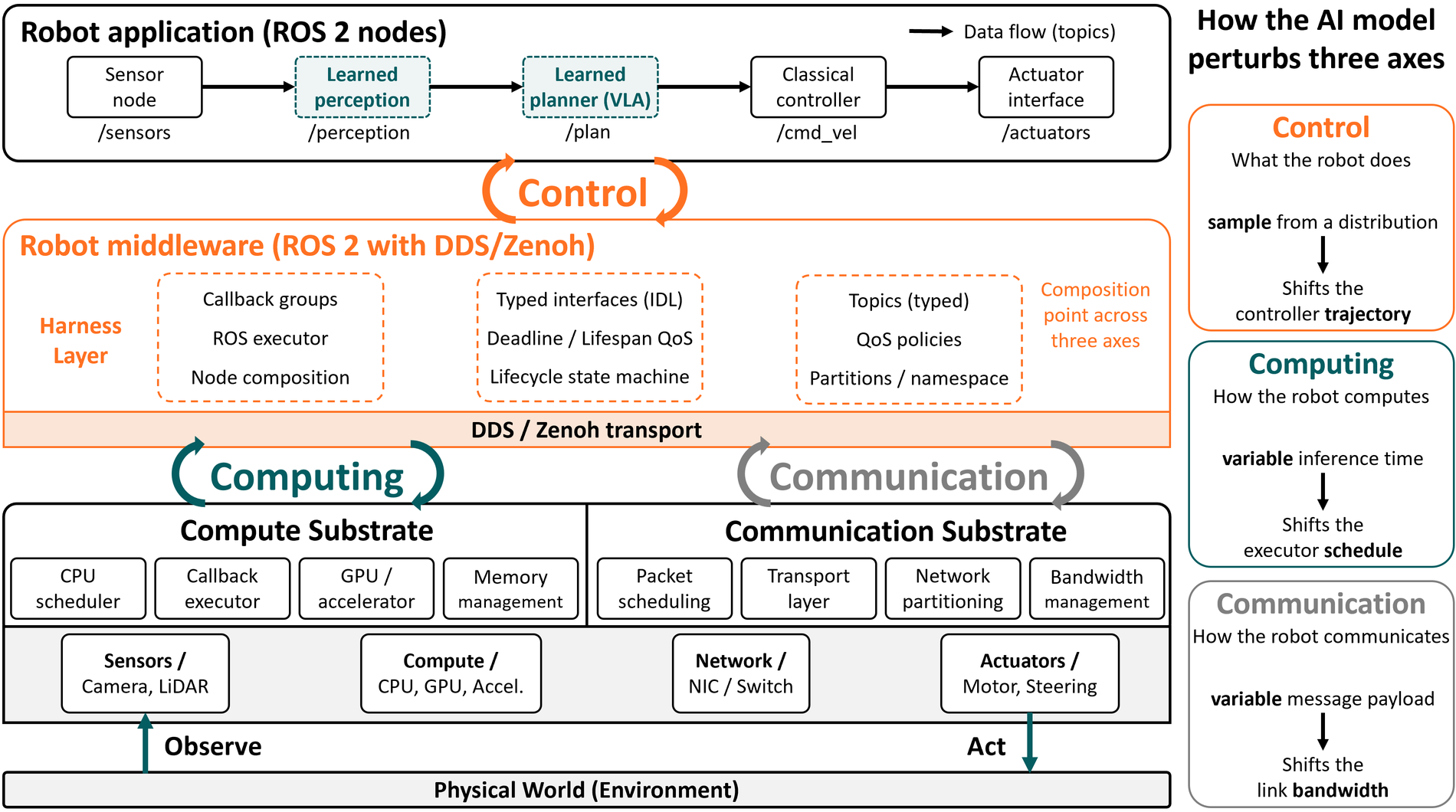
Figure 1 from the paper. The application layer runs an AI model alongside classical
nodes on the control path. Robot middleware is the robot-stack layer best positioned for joint
visibility and control over all three axes. The compute substrate and the communication substrate
each own one axis and are blind to the others. The right panel shows a single AI model disturbing
all three at once. Its output shifts the controller trajectory, its variable inference time shifts
the executor schedule, and its variable message payload shifts the link bandwidth.
What ROS 2 already has
Three components present as structure, three present only as surfaces
Reaching all three axes does not by itself make a layer a harness. Recent harness accounts synthesise
into six components, three that organise the system and three that govern what flows through it. Read
against ROS 2, the first three are already present as structure. The other three exist only as
surfaces, configuration points where a constraint can be written down while nothing enforces it.
Component
Function
ROS 2 surface
Status
Role
Who may act, and in what operational scope
nodes, namespaces, lifecycle nodes
structure
Stage
What sequences work and orders execution
launch and composition, executor, lifecycle transitions
structure
State
What is retained, replayed, and inspected
QoS history and durability, rosbag2, topic statistics
structure
Contract
How constraints on timing, format, and value are specified
RMW and type adapters, callback groups, executors, partitions
surface only
Recovery
How failures are named and responses prescribed
QoS events, lifecycle transitions, diagnostics
surface only
Each of the last three stops one step short. A ParameterDescriptor range is checked when
a parameter is set, and it leaves the per-sample output a policy publishes untouched, so a learned
sample reaches the link with its declared range unchecked. Type adapters handle typing while callback groups,
executors, and partitions handle bounding, but nothing ties them into one reservation matched to the
model's declared load. A missed deadline or a lost liveliness arrives as an event, a state transition,
or a diagnostic, and can be reported without being routed into a verified fallback.
A surface to specify a declaration exists. The mechanism that binds it to runtime behaviour does
not. Enforcing it has always been left to hand-built application code.
PIT
Three functions a Physical AI harness must host
Each mechanism consumes one of the three declarations in a form the middleware can act on. The
middleware enforces a declared contract and does not certify the declaration, which stays upstream
work.
ProjectionGates each candidate output at publication time against three concurrent
predicates, the stability of the resulting trajectory, the schedulability under the executor's
current load, and the feasibility of delivery inside the link's reserved window. A deadline or a
lifespan becomes an admission decision taken before the sample enters the loop.
IsolationWraps the model computation so its timing and resource footprint stay
inside a reservation even when its internal work does not. The reservation spans two dimensions, a
compute slot governed by callback scheduling and a communication window governed by partition and
flow control, specified together and verified as consistent.
TransferReroutes authority to a pre-staged verified baseline when the declared
distributional conditions can no longer be sustained, and reinstates model authority only after the
model's resource use has returned inside its declared bounds. The lifecycle state transition is the
natural trigger.
Why all three have to sit in the same layer
The three mechanisms close a loop, and each depends on what the others enforce. Isolation bounds the
space Projection checks, so a sample that would overrun its slot fails admission even when its
trajectory is stable. Projection's failures trigger Transfer, which holds authority at a deterministic
baseline until Isolation reports the model's resource use back inside bounds and Projection reopens
the gate. No layer below the middleware can observe all three axes at once, and no layer above can act
in the loop.
PIT composes mechanisms that already exist. Projection may call a shield or a control-barrier
predicate, Isolation may call a reservation scheduler, and Transfer may call a Simplex-style baseline.
The contribution is that all three bind to one model declaration and are evaluated as one runtime
contract. A stable command that misses its inference slot, or a timely command that falls outside the
declared operating regime, is then rejected by a single governance layer that sees both conditions at
once.
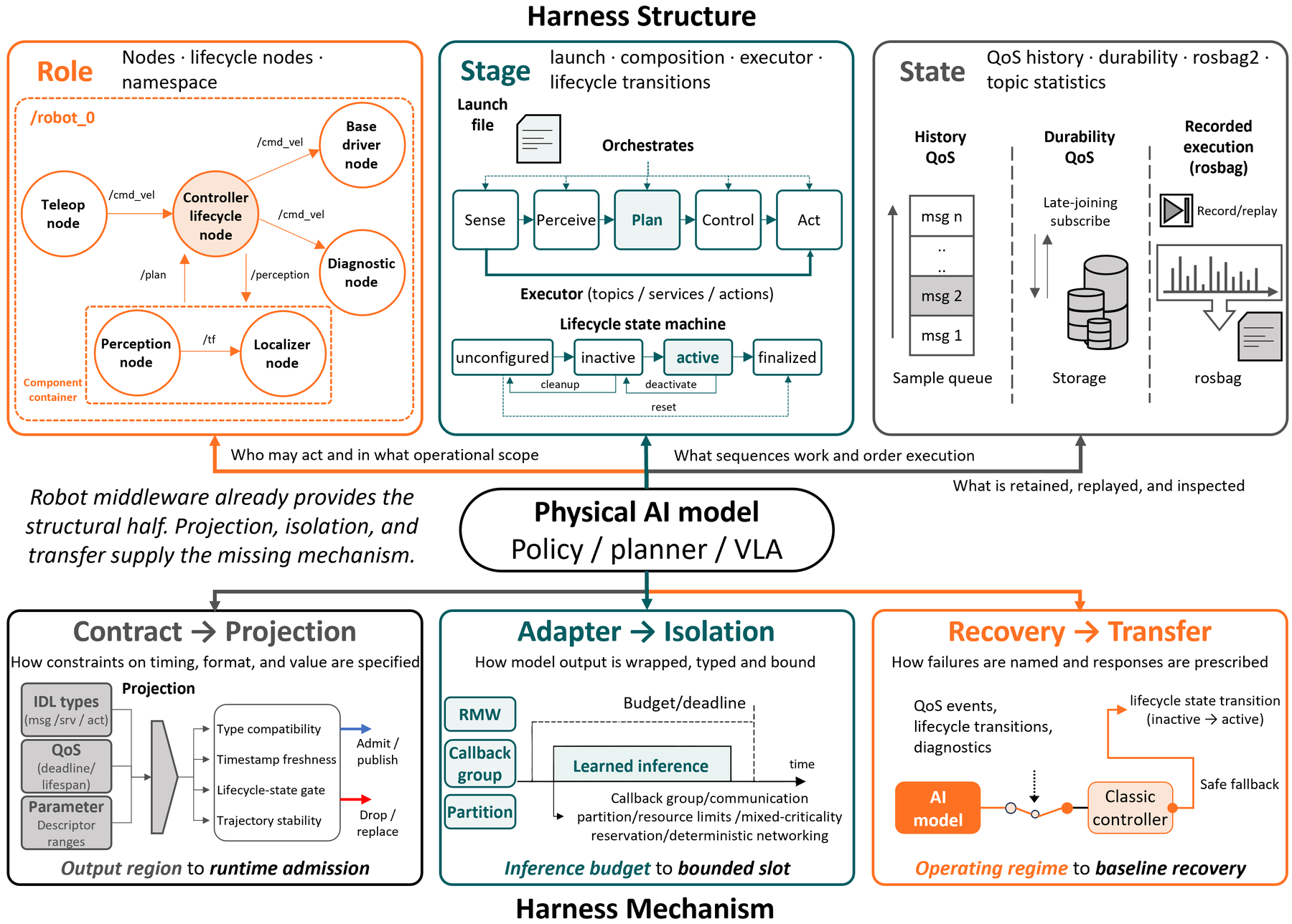
Figure 2 from the paper. An AI model declares an output region, an inference
budget, and an operating regime. The upper half shows what ROS 2 already provides as structure. The
lower half shows the three enforcement mechanisms it still lacks. Projection turns the contract
surface into a runtime admission, Isolation turns the adapter surface into a reserved slot, and
Transfer turns the recovery surface into a routed hand-off. Role, stage, and state are retained as
they are. The middleware moves from a place where contracts are declared to a place where they are
enforced.
A test for whether a system hosts a harness
Most deployed systems fail it
A deployment hosts the harness when it accepts the declared output region, inference
budget, and operating regime as one runtime contract, and composes enforcement of that
contract across control, computing, and communication in one layer.
This is what separates the harness from the runtime-assurance mechanisms it builds on. Each of those
is sound on its own axis and built per application, and each takes only the part of the declaration
that falls on that axis.
Mechanism
Axis it governs
Where it stops short
Control-barrier filter
Control
Gates the control axis without seeing the schedule or the link.
Mixed-criticality scheduler
Computing
Bounds execution with no view of control semantics or delivery.
Simplex monitor
Choice of controller
Switches controllers without a declared budget or transport contract.
Nav2 recovery behaviour
Plan health
Acts on plan health with no compute or communication reservation.
Autonomous-racing stack
Control and computing
Comes closest, tying a control-axis safety condition to a computing-axis reaction-time
change, but carries no declared contract another robot could reuse.
Relative to an external governance layer
ROS 2 has been used as a tool registry that an agent calls, and it has been wrapped by a separate
governance layer placed between the application and ROS 2. Such a framework checks each capability the
agent invokes. That check does not reach end-to-end models that emit continuous actions without
invoking discrete capabilities.
The publish path catches both. Every output leaves the application through the same publish call,
whether it comes from a discrete capability invocation or from a monolithic policy, so a Projection
hook placed there applies the same check to both. The position taken here is that robot middleware
should be the harness itself.
The Harness Profile
A deployment artifact that declares intent
The first thing to build follows directly from the failure above. A Harness Profile is a manifest,
written for example as a YAML file beside the launch description, that declares the output region, the
inference budget, and the operating regime. The Profile is only a declaration. The mechanisms that
enforce it are implemented across ROS 2, DDS, and Zenoh, binding the output region to the publish
path, the inference budget to a joint reservation, and the operating regime to a lifecycle controller
the middleware already owns.
Such a profile need not be a new programming model. It is a deployment artifact the middleware
consumes directly, and it gives the middleware a single object to admit, monitor, and revoke.
Certification of the bounds stays upstream. The Profile carries them and the middleware enforces
them. Adoption is incremental. A node that declares no profile keeps its current behaviour, and the
harness binds only the outputs a profile names, so an existing stack gains governance one model at a
time.
The profile the Nav2 evaluation actually ran
The evaluated instance expands the same declarations into per-mechanism blocks that name what
happens on each violation. Both state only the meaning of the control, timing, communication,
and fallback constraints. Node names, plugin names, and vendor callback classes appear in neither.
Semantic Harness Profile      declares meaning only
        ↓ compile
Vendor-neutral Contract IR    ObservedSample · ObservedStatus · Decision · Evidence
        ↓ backend capability check
Backend adapter, per RMW       normalise · enforce · return evidence
        ↓ deployment binding
ROS 2 application graph       topics, types, field paths, endpoints
The PIT decision core reads only the Contract IR and returns the same decision for the same input.
Each backend ships a capability descriptor, and a capability it does not declare fails closed at
profile-compile time. Neither of the two evaluated descriptors claims
native_requested_deadline_status or native_writer_ownership_transfer, so the
contract is evaluated on the surfaces the middleware exposes, namely typed samples, source timestamps,
QoS, and lifecycle state.
Where the enforcement runs
At the ROS 2 interface, on the surfaces Figure 1 marks as the harness layer
The gate sits on the typed ROS 2 path between the application graph and the DDS or Zenoh transport.
It reads typed samples, source timestamps, QoS state, and lifecycle state, and it admits, replaces,
or withholds each sample before the actuator endpoint. These are the surfaces the paper
identifies as the middleware's mediated abstractions, and they are the ones Figure 2 draws under
Contract, Adapter, and Recovery.
Robot middleware here means what the paper means by it, the composition of ROS 2 over a DDS or Zenoh
transport. Its contribution across the three axes is a set of interception surfaces, so an enforcement
point placed on those surfaces sits at the middleware layer by construction. Neither controller was
touched, and no node in the Nav2 graph was modified.
The failure the paper opens with is the one injected here. A control-barrier filter admits a
steering command that is stable, but the inference that produced it overran its budget, so the
executor missed the deadline and the command reaches the link late. The filter saw a safe trajectory,
the scheduler a late task, and the network a large frame. None of them saw that the late safe command
is now unsafe, and no fallback fires because no layer wired the budget overrun to the hand-off. In
what follows, Nav2's Collision Monitor plays the filter's part.
We evaluate on ROS 2 Nav2 with two public learned navigation policies, DRL and DRL-VO,
and DWB as the verified fallback. Enforcement sits at the ROS 2 boundary after the Collision
Monitor and before the actuator.
The fault
An unexpected processing delay. After ten non-zero commands the boundary begins holding each
command from the learned controller for 121 ms, 120 ms of compute and 1 ms of transport, and
keeps that up for a 3-second burst. The command in flight when the burst begins is frozen, so
the actuator keeps receiving that same value while the robot moves on. It stays inside the declared
value bounds the whole time. The Profile allows 80 ms of staleness and a 40 ms compute budget, so
only the clock is violated.
The two policies
Both are public checkpoints from TempleRAIL/drl_vo_nav,
trained in the same environment with the same observation and action families. They share an
architecture and differ in one reward term, which is the kind of difference the harness should be
indifferent to.
DRL
without the VO heading term
drl_vo/src/model/drl.zip. Ported from the upstream ROS 1 node, since the official
ROS 2 branch packages only the DRL-VO checkpoint.
DRL-VO
with the VO heading term
drl_vo/src/model/drl_vo.zip. The velocity-obstacle based heading-direction reward
term is included during training.
Both are sensor-conditioned, meaning they map each observation directly to a command. Both open under the same observation-space shape, action-space
shape, CustomCNN class, and Stable-Baselines3 loader, and both emit a bounded
Twist through the same planner binding. The source commit and both checkpoint SHA-256
values are pinned in the run manifest.
How the Profile composed with them
The point is what the Profile does not contain. It carries no policy name, no checkpoint
path, and no controller class. It states value bounds, a freshness limit, a rate and compute budget, a
delivery deadline, and a fallback role. Which policy sits behind the logical port is a deployment
binding, and the contract stays the same across all of them.
The policy emits a candidate command on the logical port. The Profile never sees which policy it is.
Isolation observes rate, compute budget, and delivery deadline at the middleware boundary and detects the timing violation.
Projection evaluates value bounds and sample age under one joint contract, and denies publication of the stale command.
Transfer revokes the learned controller's authority lease and hands off to DWB, requiring the fallback output to be fresh before it is admitted.
Evidence is returned as a vendor-neutral trace: policy label, checkpoint hash, model input checksum, raw action, bounded Twist, and observation-to-candidate latency.
The compiled Profile was byte-identical and hash-identical across all four cells. Swapping DRL for
DRL-VO, or Fast DDS for Cyclone DDS, changed the deployment binding and
RMW_IMPLEMENTATION only. Application source modified: 0 LOC. Controller source
modified: 0 LOC.
Where the obstacle comes from
The obstacle is not placed at a fixed coordinate. It is spawned at a fixed
predicted arc length of about 1.04 m along the arc obtained by integrating the command that was
sitting in the queue at the moment the fault fired. Across all ten held-out seeds and both arms the
range stays within 1.036 to 1.045 m.
This is deliberate. Placing the obstacle on the predicted arc means every run meets an obstacle
that is equally in its own way. The
contract, the fault, the selection threshold, the arc length, and the obstacle duration are all fixed
in one byte-identical file.
The consequence is visible below. The two panels place the obstacle at different coordinates because
the queued angular velocity differed (−0.112 rad/s against +0.102 rad/s, giving bearings of −13.0° and
+11.7° from the robot heading). Same rule, same arc length, different queued command. The dotted
gold arc in the plan view below is that prediction.
What actually happens
The two runs below are the same matched pair the figures draw. Press play and the robot moves along
the pose trace each run actually recorded, the obstacle appears at the moment it was activated, and
every stale command, projection block, and transfer fires at its recorded timestamp. The gold marker
is where the delay starts.
0.00 s
This is a replay of the recorded pose traces and event timestamps. The scene is drawn from the recorded positions, with the TurtleBot3 Burger body and the
obstacle both to scale. The obstacle is the cylinder the runs actually spawn, 0.25 m in radius and
0.80 m tall. Positions come from the navigation feedback trace at about 6 Hz and are interpolated
between samples. The replay stops the robot at the moment the two footprints meet, because the
obstacle is a solid body and that is where the encounter ends. The verdict shown at the end is the
audited minimum from the clearance monitor, which samples independently and less often. The two agree
for PIT at +0.22 m. For Profile-off the pose trace dips to −0.42 m while the audited minimum is
−0.31 m, and the verdict is an overlap on either stream.
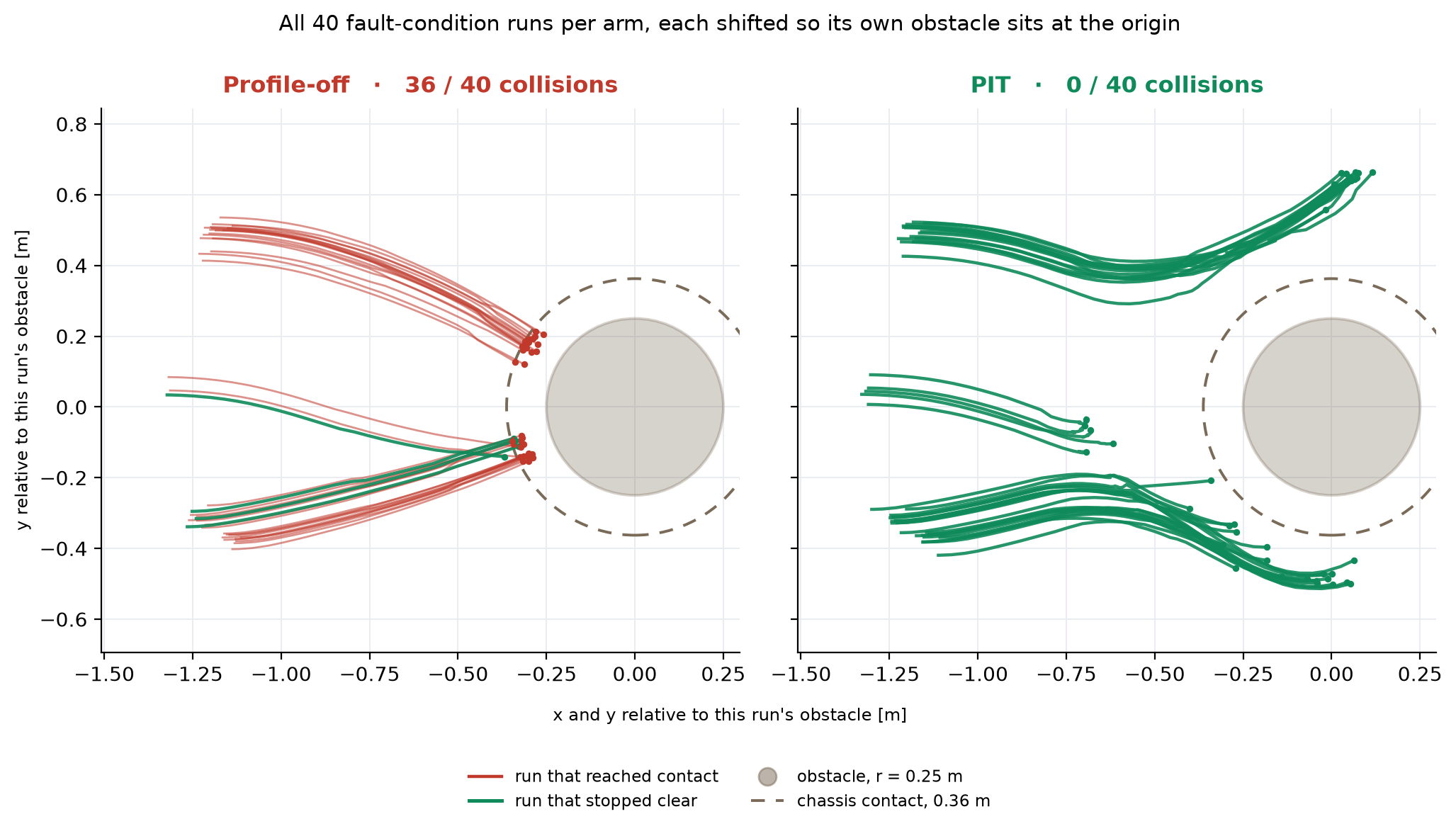
Every fault-condition run in the locked matrix, 40 on each side. Each run places its own
obstacle on the arc predicted from the command that was queued when the delay began, so the
obstacles land across a spread of about 0.94 m in y and the trajectories fan out with them.
Left, 36 of the 40 runs close to within the 0.47 m combined footprint. Right, none of
them do. The four Profile-off runs that stayed clear are the ones whose queued command steered them
away from their own obstacle.
The figure is generated from the run records by
analysis/plot_c7_all_runs.py, and the replay above by
analysis/make_replay_payload.py. Both ship with the repository.
0 / 40
collisions under fault with PIT (36 / 40 without)
40 / 40
runs handed off to fresh DWB control
0 / 80
false transfers in normal operation
0 LOC
application and controller source changed
Collisions under the fault condition
DDS
Policy
Profile-off
PIT
Risk reduction
95% CI
McNemar p
Fast DDS
DRL
8/10
0/10
0.80
[0.50, 1.00]
0.0078
Fast DDS
DRL-VO
10/10
0/10
1.00
[1.00, 1.00]
0.0020
Cyclone DDS
DRL
9/10
0/10
0.90
[0.70, 1.00]
0.0039
Cyclone DDS
DRL-VO
9/10
0/10
0.90
[0.70, 1.00]
0.0039
Equal-weighted across the four strata, the collision-risk reduction is 0.900, stratified
bootstrap 95% CI [0.800, 0.975]. Including the normal baseline, the difference-in-differences
benefit is 0.875, CI [0.775, 0.975]. Minimum-clearance benefit under fault is
+0.3255 m, CI [+0.2920, +0.3575] m. Collision here means geometric footprint overlap at
a combined radius of 0.47 m.
What the mechanism did
Observation under fault
Profile-off
PIT
Runs admitting a stale final command at the actuator boundary
40/40
0/40
Stale commands admitted
447
0
Transfer to DWB
0/40
40/40
DWB local-plan evidence and first fresh fallback command confirmed
0/40
40/40
Isolation detected the timing violation, Projection denied publication under the joint contract, and
Transfer initiated the handoff. Handoff latency was 302.39 ms median and 371.46 ms at
p95. All 160 trials reached SUCCEEDED or HORIZON_COMPLETE.
Portability
What the claim is, stated precisely
A new DDS requires a backend capability descriptor and its connector. It does not require
changes to the Harness Profile semantics, the PIT core, the learned controller, the fallback
controller, or the application code.
The same profile ran unchanged across Fast DDS and Cyclone DDS and across both policies. Swapping
the backend changes RMW_IMPLEMENTATION and the backend identity only. We do not claim
that every DDS is supported automatically without a connector. What the two backends demonstrate is
that the decision core is RMW-agnostic at the ROS 2 interface.
Open directions
What it takes to build each binding, and the hard part of each
The Nav2 evaluation shows the composition holding on one fault under one stack. Turning it into a
platform capability means building three bindings into the middleware itself. Each has a part that is
genuinely open, and naming it is more useful than claiming the binding is straightforward.
Projection needs a hook in the publish path
A ROS 2 message reaches the link through a fixed path. A publish call hands the sample down through
the client library to the RMW layer and then to DDS, and nothing along that path provides a generic
semantic admission gate that checks a learned output against its declared control, schedule, and link
contract. Projection needs a predicate evaluated before the sample is handed down, one that can admit
it, drop it, or replace it with the last admitted value. An autonomous-racing stack already runs such
a predicate over its learned output every cycle, but it does so in application code.
The hard part. Observation is not free. How often should the hook check to
balance that cost against its benefit, and what latency can a per-sample predicate afford at a 1 kHz
control rate before it becomes the bottleneck it was meant to police?
Isolation needs one reservation primitive
Today a developer who wants to bound a model's footprint sets two things separately, a callback group
on the executor and a partition with a bandwidth limit on the DDS side, and nothing checks that the
two are consistent or that together they fit the model's declared load. Isolation asks for a single
primitive that takes a declaration of output rate, payload size, and worst-case inference time,
derives both settings jointly, and admits or rejects the reservation against what the platform has
already committed. Mixed-criticality scheduling and DDS-over-TSN supply the analysis, and what is
missing is their integration into the one reservation a robot declares and the middleware admits.
The hard part. The admission test. Certifying that a new model load fits is not
two independent checks but one joint check across compute and communication, because a reservation
that is feasible on each axis alone can be infeasible when both are claimed at once. The admission
test is what certifies the composition.
Transfer needs a lifecycle controller
ROS 2 managed nodes already provide the state machine Transfer needs, an active state, an inactive
state, and transitions between them. Today those transitions are commanded by an operator or a launch
script, with no automatic trigger and no defined way back. Transfer asks for a controller in the
middleware that consumes a distributional indicator the model emits, an out-of-distribution score or a
confidence estimate, drives the active-to-inactive transition itself, and activates a verified
baseline node staged in advance.
The hard part. The return. Reinstating the model takes a positive signal. It has
to run inside its declared bounds, confirmed by the reservation monitor, long enough to be trusted
again. How long, and confirmed by what, are open questions that can
be answered by building the controller and characterising it against the Nav2 recovery behaviours,
which today wire each fallback to a failure mode its developers anticipated in advance.
The instrument this field does not have
The language-agent community made a methodological move that robotics can copy outright. It reported
the harness together with the model, and built benchmarks that held the model fixed and swapped the
harness, where reliability then moved by an order of magnitude. Physical AI has no such
instrument.
A harness card
a manifest carried with the launch description
Records the output region it enforced, the inference budget it held, and the baseline it kept
staged, so two deployments can be compared on their governance as well as their collision
rate.
A harness benchmark
the more valuable deliverable
Fix a learned policy, vary the harness around it, and measure how much of a robot's safety and
reliability the harness itself accounts for.
For a decade the robot middleware community competed on one axis, which transport had the lowest
latency, which executor the tightest jitter, which discovery protocol scaled to the largest fleet.
That competition was productive and it is not finished. Physical AI moves the binding constraint. When
a learned model can swing a robot's reliability by an order of magnitude depending on what governs it,
the layer that governs the model matters more than the layer that delivers its messages a few
microseconds sooner.
Reproducibility
Integrity audit of the reported matrix
160 / 160 valid runs. No invalid or missing trials.
matrix_complete = true, mechanism_invariants_passed = true, zero
mechanism failures.
160 result records, 160 model sidecars, and 160 gzip raw observation traces verified by SHA-256.
Zero trace hash mismatches. The Collision Monitor was preserved in both modes.
The run manifest carries SHA-256 for the trial runner, the parameter generator, the Harness
Profile, and the Nav2 parameter file. The analyser excludes any record without the locked revision.
Harness ProfileThe semantic profile, its compiled
deployment form, and the per-RMW capability descriptors.
Results and statisticsAll 160 audited run records, the
trial-level table, and the locked statistics behind every number here.
Runner and analyserThe trial runner, the audit and
statistics analyser, and the figure and replay scripts.
Core and adaptersThe PIT decision core, the Nav2
adapters, and the Fast DDS and Cyclone DDS capability descriptors.
Start with Verify the published numbers, which
re-derives every figure in this page from the shipped run records and needs nothing but Python. The
DRL and DRL-VO checkpoints stay with their upstream project, and the README explains how to fetch and
hash-check them.
Note. This page accompanies a Big Ideas paper currently in shepherding for ACM Middleware 2026.
Numbers here are from the locked held-out evaluation and will not change. The text may still be
revised as the camera-ready is prepared.
Cite
Big Ideas track, ACM Middleware 2026
@inproceedings{lee2026harness,
  title     = {Harness Engineering for Physical {AI}:
               Robot Middleware Is the Harness Layer},
  author    = {Lee, Sanghoon and Chae, Jiyeong and Park, Kyung-Joon},
  booktitle = {Proceedings of the ACM/IFIP International Middleware
               Conference (Big Ideas Track)},
  year      = {2026},
  note      = {arXiv:2606.09416}
}
The preprint is on arXiv:2606.09416. Correspondence to
Sanghoon Lee at DGIST.